


Off-Page SEO That Compounds: Earn Trust, Build Authority, and Keep Your Site Audit-Ready

Off-page SEO is where visibility becomes reputation.
You can publish great content, optimize headings, and fine-tune meta tags—but if the broader web never references your site, search engines receive limited external proof that your pages deserve top positions. Off-page signals act like endorsements. They tell Google and other search engines that people outside your domain find your brand useful, credible, and worth citing.
At the same time, off-page work only pays off when your website can “hold” the value it earns. If your site has broken links, duplicate pages, redirect chains, or messy metadata, you may build authority externally while losing it internally through technical leaks. This is why the strongest SEO programs treat off-page growth and site auditing as one connected system.
In this refreshed version, you’ll learn a cleaner way to think about off-page SEO, a set of tactics that work long term, and a practical audit routine. For the technical side, tools like Netpeak Spider can help you crawl your website, surface issues fast, and prioritize fixes before they affect rankings.

A Better Definition of Off-Page SEO
Most explanations say off-page SEO is “everything outside your website.” True—but here’s the more useful framing:
- On-page SEO improves relevance and clarity: keywords, content, internal linking, meta tags, page structure, and technical accessibility.
- Off-page SEO improves credibility and confidence: backlinks, brand mentions, reviews, citations, and signals that your brand is recognized elsewhere.
On-page work tells search engines what your page is about. Off-page work helps search engines decide whether to trust it.
If you want a quick rule: on-page is your résumé; off-page is your references.
Why Off-Page SEO Still Moves the Needle
Search engines must rank pages under uncertainty. They do not personally verify every business, every claim, or every product. Instead, they look for patterns of validation—especially from the broader web.
Strong off-page SEO tends to improve outcomes in three ways:
- Authority lift: high-quality backlinks and mentions increase perceived expertise.
- Discovery expansion: referral traffic and social amplification bring new audiences and engagement signals.
- Algorithm resilience: a trusted brand profile usually withstands search volatility better than isolated keyword wins.
In other words, off-page SEO is how your site becomes harder to ignore.
Off-Page SEO vs “Link Building”: What People Get Wrong
Many teams reduce off-page SEO to link building and then chase volume. That’s where things go sideways.
Modern off-page SEO is less about collecting links and more about earning citations through value. The safest profile is the one that looks like it happened naturally: relevant sources, steady acquisition, and content worth referencing.
When off-page strategy is too mechanical—paid links, irrelevant placements, unnatural spikes—it can backfire. A sustainable plan is slower, but it compounds.

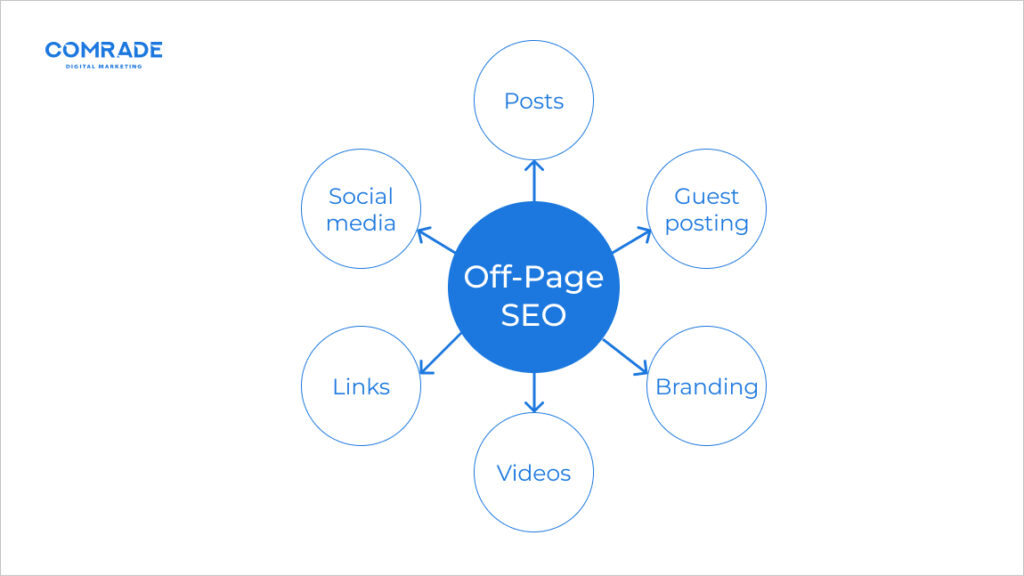
Six Off-Page SEO Plays That Work Long Term
Instead of spreading effort across dozens of tactics, focus on a small group of activities that create consistent external signals.
1) Publish “reference content,” not only blog posts
Reference content is the kind of page that other websites naturally cite. Examples include:
- Original research and surveys
- Industry benchmarks and statistics
- Frameworks, templates, and calculators
- Glossaries that clarify confusing concepts
Standard blog posts can rank, but reference content is what earns links over time without constant outreach.
2) Digital PR: turn information into mentions
Digital PR is one of the fastest ways to earn high-authority coverage. The goal is not “press for the sake of press.” The goal is creating something a publisher wants to quote.
What tends to work:
- New data (your data or aggregated insights)
- Trend commentary with a unique angle
- Case studies that show measurable results
- Timely insights tied to real events in your industry
PR works especially well when the pitch is valuable even if your product is never mentioned.
3) Partnership backlinks (the underrated path)
Partnerships are often cleaner than cold outreach because the relationship already exists. Common partnership link sources include:
- Integration pages (“Works with…” directories)
- Certified partner lists
- Co-marketing webinars and recap pages
- Affiliate resource pages (done ethically and transparently)
These links tend to be stable and contextually relevant, which is exactly what you want.
4) Thoughtful guest contributions (quality > volume)
Guest posting is not dead, but it must be done carefully. Avoid low-quality networks. Instead, contribute to a small number of high-fit publications where your audience already reads.
A good guest post is not an ad. It’s a useful piece of content that earns a contextual mention naturally.
5) Reviews and third-party proof as trust signals
Reviews do more than improve conversion. They build reputation. That reputation can influence branded searches, click-through rates, and even the willingness of other sites to reference you.
Good review hygiene looks like this:
- Ask for reviews at the right moment (after a success, not during friction)
- Respond to negative feedback with solutions, not defensiveness
- Keep tone consistent with your brand voice
Authenticity matters. Shortcuts tend to create long-term damage.
6) Local presence (when location matters)
If your business serves a region, local off-page SEO can be a major advantage. Two pillars matter most:
- Google Business Profile: accurate information, updated posts, photos, and steady review activity.
- NAP consistency: Name, Address, Phone must match across directories and social listings.
Consistency reduces doubt. Doubt reduces rankings.
Why Audits Are Part of Off-Page SEO (Even If That Sounds Odd)
Off-page SEO is like pouring water into a bucket. Technical issues are holes in the bucket.
If your site has a large number of 404s, redirect chains, duplicated pages, or weak internal linking, you may still grow—but you will grow slower than you should. External authority needs clean pathways to flow through your site.
Common “authority leaks” include:
- Broken internal links that waste crawl attention and disrupt user paths
- Duplicate content that splits ranking signals across similar pages
- Redirect chains that dilute equity and slow crawling
- Thin metadata that makes pages feel redundant in search results
- Orphan pages that cannot earn visibility because nothing points to them internally
This is why a consistent crawling process matters—not because it is glamorous, but because it prevents silent losses.
A Repeatable Audit Routine With Netpeak Spider
A reliable audit does not require complex tooling or endless spreadsheets. It requires a crawler that can scan your site, reveal problems quickly, and help you prioritize fixes. Netpeak Spider is built for this kind of structured auditing, and it works for both macOS and Windows environments.
Here’s a clean process you can use monthly (or after major site changes):
Phase A: Crawl and diagnose
- Run a full crawl to capture status codes, indexability, and internal link relationships.
- Export or tag the issues by severity so you can focus on what blocks performance first.
Phase B: Fix high-severity errors first
- Resolve 4xx errors and broken internal links.
- Reduce redirect chains and loops.
- Confirm canonical tags are pointing where they should.
Phase C: Clean up duplication and clarity signals
- Address duplicate titles and descriptions.
- Review pages with missing or weak metadata.
- Identify duplicate or near-duplicate pages that compete with each other.
Phase D: Improve internal distribution of authority
- Find orphan pages and connect them to relevant hubs.
- Reduce crawl depth for important pages so search engines reach them faster.
- Strengthen internal linking between top-performing content and related pages.
When you run audits regularly, off-page SEO becomes more efficient. Each new mention or backlink has a stronger chance of translating into rankings because the site is structurally sound.
If you want a tool that helps you identify broken links, duplicates, and metadata errors quickly so your SEO foundation stays stable, Netpeak Spider is worth adding to your workflow.
How to Measure Off-Page Progress Without Obsessing Over Vanity Metrics
Off-page SEO can feel abstract if you only track “number of backlinks.” Instead, measure outcomes that show your authority is translating into visibility and business value.
| Signal | What it suggests | Why it matters |
|---|---|---|
| Referring domains growth | More unique sources referencing you | Diversity usually builds trust |
| Branded search lift | People actively seek your brand | Brand demand strengthens resilience |
| Referral traffic quality | Links drive real users, not bots | Shows relevance, not just SEO value |
| Ranking stability | Less volatility over time | Trust reduces fragility |
These indicators tell you whether your off-page efforts are compounding rather than just “looking good on paper.”
Final Thoughts: Build Authority, Then Protect It
Off-page SEO is not a one-time project. It is a reputation-building practice. When you earn meaningful mentions and backlinks, your website gains credibility. When your site is technically clean, that credibility converts into rankings more reliably.
A strong strategy therefore has two halves: (1) consistent off-page activity that earns trust, and (2) routine auditing that prevents authority from leaking through technical issues. If you want a practical way to crawl your site and catch problems like broken links, duplicate pages, and metadata errors before they limit performance, Netpeak Spider can help make audits faster and more repeatable.
In the long run, the brands that win search are rarely the ones with the most tactics. They are the ones with the most consistent systems.


